Gear Ratio Chart: Best Gears for 33–40+ Inch Tires
Free tool
Big Tire Planner
Pick your rig, enter your tire size and current gears, and get the right axle ratio, your new RPM at highway speed and a drawing of your truck on the new tires. Works from stock up to 54 inches.
Simple guide to choosing the best diff gear ratios for your Jeep or 4x4 truck
I often get questions like:
- What is the best gear ratio for 37 inch tires?
- What gear ratio do I need for 35 inch tires?
- What does a 1:1 gear ratio mean?
- What diff gear ratio is best for fuel economy?
- What is the best rear end gear ratio for my Chevy Silverado?
- What axle ratio gears should I run with for 38 inch tires on my 4x4 Ford F-150?
If you are planning on 35" or 37" or even bigger tires for your Jeep or 4x4 truck, this guide shows you the best ratio to choose. You'll find the formulas and a simple chart that shows how much you should lower your ring and pinion gear ratio.
Quick Answers: Best Gear Ratio for 33, 35, 37 and 40 Inch Tires
Many trucks and Jeeps come with tires around 31" and 3.73 gears. Starting from there, the formula below gives these ratios:
| New tire | Exact ratio | Closest common gears |
|---|---|---|
| 33" | 3.97 | 4.10 |
| 35" | 4.21 | 4.30 |
| 37" | 4.45 | 4.56 |
| 38" | 4.57 | 4.56 |
| 40" | 4.81 | 4.88 |
Different stock tires or gears give different answers. Put your own numbers into the Big Tire Planner to get the ratio for your rig.
1:1 Gear Ratio
A gear ratio of 1:1 means that the driven gear rotates at the same speed as the driving gear. In a manual transmission this is usually 4th gear, where the engine and the transmission output turn at the same speed. Go higher and you are in overdrive, where the output of the transmission turns faster than the engine.
Differential Gear Ratio
The gear ratio most interesting to 4x4 truck owners is the ratio between the driveshaft and the axles: the differential gear ratio, or axle gear ratio. It is set by the number of teeth on the ring gear versus the pinion. A ratio of 4.56 means that for every full turn of the axle, the driveshaft turns 4.56 times. The higher the number, the lower the gearing.
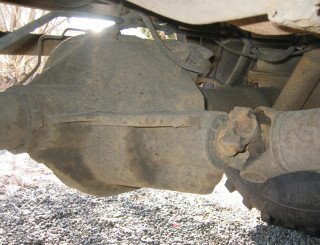
The correct axle gear ratio is important for drivability and economy. When you fit bigger tires without changing the gears, fuel consumption goes up, the truck feels sluggish in top gear, and you can no longer crawl at the low speeds needed off road.
A Simple Formula
The simplest formula for the correct gear ratio is this:
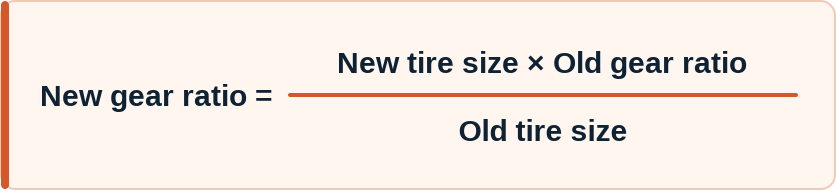
Example: the original tire size is 30" and the original gear ratio is 3.91. You plan on moving up to 38". The formula gives (38 × 3.91) ÷ 30 = 4.95. Not every ratio is available, so you choose between 4.88 and 5.13, with 4.88 being the closest.
Pick the higher number (5.13 in the example) if you do a lot of off-road driving or towing, and the lower number (4.88) if you do more long-distance highway trips.
Engine RPM Formula
To work out the engine speed at a given road speed, use this formula. It is for a 1:1 top gear (no overdrive), so it works for a manual transmission, and for an automatic when it is not in overdrive.
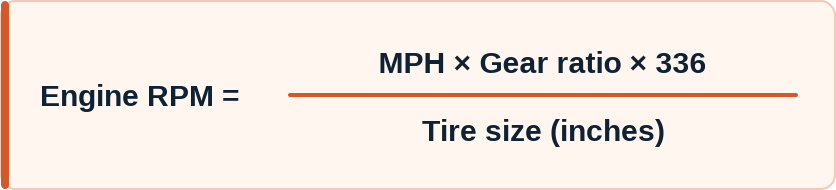
Example: continuing from above, start with 65 mph, a common highway speed. Multiply by 3.91 and by 336, then divide by 30: that gives 2,846 RPM before the swap. With 4.88 gears and 38" tires you get 2,805 RPM, almost the same as stock.
Skip the math
Your tire size not in the chart?
The Big Tire Planner does this calculation for any tire size, axle ratio and speed, and shows which standard ring and pinion ratio is closest.
Crawl Ratio: Transmission, Transfer Case and Axle Gears
Axle gears are only part of the story. Off road, what counts is the crawl ratio: how many times the engine turns for each turn of the wheels in your lowest gear. The higher the number, the slower and more controlled the truck creeps over rocks, and the more engine braking you get on steep descents.
Crawl ratio = transmission 1st gear × transfer case low range × axle ratio
Example: a 2.47 first gear, a 2.48:1 transfer case in 4Lo and 4.88 axles give 2.47 × 2.48 × 4.88 = 29.9:1.
Most stock trucks land between about 25:1 and 50:1. A Jeep Wrangler Rubicon (JL) is around 77:1 with the automatic and 84:1 with the manual, and serious rock crawlers run 100:1 or more.
Where the axle ratio comes from
The axle ratio is the number of teeth on the ring gear divided by the teeth on the pinion. A 39-tooth ring and an 8-tooth pinion give 39 ÷ 8 = 4.875, sold as 4.88 gears.
Common transfer case low ranges
| Transfer case | Found in | Low range |
|---|---|---|
| NP205 | Older Ford, GM and Dodge trucks | 1.96:1 |
| Dana 20 | Older Jeeps, Scouts, Broncos | 2.03:1 |
| Dana 300 | Jeep CJ (1980–86) | 2.62:1 |
| Borg-Warner 1356 | Ford F-150 and Bronco | 2.69:1 |
| NP231, NP241, NP242 | Jeep, Dodge and GM | 2.72:1 |
| Toyota (most later trucks) | Tacoma, 4Runner, Hilux | 2.57:1 |
| NP241OR Rock-Trac | Jeep Wrangler Rubicon | 4.00:1 |
| Atlas (Advance Adapters) | Aftermarket | 2.0 to 5.0:1 |
To lower the crawl ratio without regearing the axles, you can fit a transfer case with a lower low range or add a crawler box (a second reduction gear). Regearing the axles lowers every gear, highway included, so with bigger tires it is usually the first job: see the chart below.
A 4x4 Differential Gear Ratio Chart Table
To sum it all up, this table works for both your front and rear axle gear ratio. It is based on the RPM formula above and shows the engine RPM at 65 mph. Find your new tire size, then pick an axle ratio in the green band, close to the RPM your truck had on stock tires.
| Tire | 3.31 | 3.42 | 3.55 | 3.73 | 3.91 | 4.11 | 4.27 | 4.56 | 4.88 | 5.13 | 5.29 | 5.38 | 5.71 | 6.17 | 7.17 |
|---|---|---|---|---|---|---|---|---|---|---|---|---|---|---|---|
| 30" | 2,410 | 2,490 | 2,584 | 2,715 | 2,846 | 2,992 | 3,109 | 3,320 | 3,553 | 3,735 | 3,851 | 3,917 | 4,157 | 4,492 | 5,220 |
| 31" | 2,332 | 2,409 | 2,501 | 2,628 | 2,755 | 2,896 | 3,008 | 3,213 | 3,438 | 3,614 | 3,727 | 3,790 | 4,023 | 4,347 | 5,051 |
| 32" | 2,259 | 2,334 | 2,423 | 2,546 | 2,669 | 2,805 | 2,914 | 3,112 | 3,331 | 3,501 | 3,610 | 3,672 | 3,897 | 4,211 | 4,894 |
| 33" | 2,191 | 2,263 | 2,349 | 2,469 | 2,588 | 2,720 | 2,826 | 3,018 | 3,230 | 3,395 | 3,501 | 3,561 | 3,779 | 4,083 | 4,745 |
| 34" | 2,126 | 2,197 | 2,280 | 2,396 | 2,512 | 2,640 | 2,743 | 2,929 | 3,135 | 3,295 | 3,398 | 3,456 | 3,668 | 3,963 | 4,606 |
| 35" | 2,065 | 2,134 | 2,215 | 2,328 | 2,440 | 2,565 | 2,664 | 2,845 | 3,045 | 3,201 | 3,301 | 3,357 | 3,563 | 3,850 | 4,474 |
| 36" | 2,008 | 2,075 | 2,154 | 2,263 | 2,372 | 2,493 | 2,590 | 2,766 | 2,961 | 3,112 | 3,209 | 3,264 | 3,464 | 3,743 | 4,350 |
| 37" | 1,954 | 2,019 | 2,095 | 2,202 | 2,308 | 2,426 | 2,520 | 2,692 | 2,881 | 3,028 | 3,123 | 3,176 | 3,370 | 3,642 | 4,232 |
| 38" | 1,902 | 1,966 | 2,040 | 2,144 | 2,247 | 2,362 | 2,454 | 2,621 | 2,805 | 2,948 | 3,040 | 3,092 | 3,282 | 3,546 | 4,121 |
| 39" | 1,854 | 1,915 | 1,988 | 2,089 | 2,190 | 2,302 | 2,391 | 2,554 | 2,733 | 2,873 | 2,962 | 3,013 | 3,198 | 3,455 | 4,015 |
| 40" | 1,807 | 1,867 | 1,938 | 2,037 | 2,135 | 2,244 | 2,331 | 2,490 | 2,664 | 2,801 | 2,888 | 2,937 | 3,118 | 3,369 | 3,915 |
| 41" | 1,763 | 1,822 | 1,891 | 1,987 | 2,083 | 2,189 | 2,275 | 2,429 | 2,599 | 2,733 | 2,818 | 2,866 | 3,042 | 3,287 | 3,819 |
| 42" | 1,721 | 1,778 | 1,846 | 1,940 | 2,033 | 2,137 | 2,220 | 2,371 | 2,538 | 2,668 | 2,751 | 2,798 | 2,969 | 3,208 | 3,728 |
| 43" | 1,681 | 1,737 | 1,803 | 1,894 | 1,986 | 2,087 | 2,169 | 2,316 | 2,479 | 2,606 | 2,687 | 2,733 | 2,900 | 3,134 | 3,642 |
| 44" | 1,643 | 1,698 | 1,762 | 1,851 | 1,941 | 2,040 | 2,119 | 2,263 | 2,422 | 2,546 | 2,626 | 2,670 | 2,834 | 3,063 | 3,559 |
| 45" | 1,606 | 1,660 | 1,723 | 1,810 | 1,898 | 1,995 | 2,072 | 2,213 | 2,368 | 2,490 | 2,567 | 2,611 | 2,771 | 2,995 | 3,480 |
| 46" | 1,572 | 1,624 | 1,685 | 1,771 | 1,856 | 1,951 | 2,027 | 2,165 | 2,317 | 2,436 | 2,512 | 2,554 | 2,711 | 2,929 | 3,404 |
| 47" | 1,538 | 1,589 | 1,650 | 1,733 | 1,817 | 1,910 | 1,984 | 2,119 | 2,268 | 2,384 | 2,458 | 2,500 | 2,653 | 2,867 | 3,332 |
| 48" | 1,506 | 1,556 | 1,615 | 1,697 | 1,779 | 1,870 | 1,943 | 2,075 | 2,220 | 2,334 | 2,407 | 2,448 | 2,598 | 2,807 | 3,262 |
| 49" | 1,475 | 1,524 | 1,582 | 1,663 | 1,743 | 1,832 | 1,903 | 2,032 | 2,175 | 2,287 | 2,358 | 2,398 | 2,545 | 2,750 | 3,196 |
| 50" | 1,446 | 1,494 | 1,551 | 1,629 | 1,708 | 1,795 | 1,865 | 1,992 | 2,132 | 2,241 | 2,311 | 2,350 | 2,494 | 2,695 | 3,132 |
| 51" | 1,417 | 1,465 | 1,520 | 1,597 | 1,674 | 1,760 | 1,829 | 1,953 | 2,090 | 2,197 | 2,265 | 2,304 | 2,445 | 2,642 | 3,070 |
| 52" | 1,390 | 1,436 | 1,491 | 1,567 | 1,642 | 1,726 | 1,793 | 1,915 | 2,050 | 2,155 | 2,222 | 2,260 | 2,398 | 2,591 | 3,011 |
| 53" | 1,364 | 1,409 | 1,463 | 1,537 | 1,611 | 1,694 | 1,760 | 1,879 | 2,011 | 2,114 | 2,180 | 2,217 | 2,353 | 2,543 | 2,955 |
| 54" | 1,339 | 1,383 | 1,436 | 1,509 | 1,581 | 1,662 | 1,727 | 1,844 | 1,974 | 2,075 | 2,140 | 2,176 | 2,309 | 2,495 | 2,900 |
under 2,200: too low, sluggish2,200–2,4992,500–3,000: about right3,001–3,300over 3,300: too high
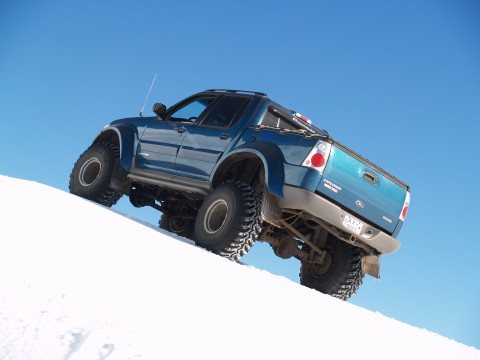
The green band is where most trucks sit on stock tires and gears. As an example, 38" tires and 4.88 gears on a Ford Sport Trac give about 2,800 RPM in this chart and drive well. With an overdrive top gear the real engine speed is lower (multiply by the overdrive ratio, often 0.7–0.8), but the chart still shows which axle ratio brings your truck back to its stock gearing.
Lower numbers give better fuel economy and quieter highway cruising. Higher numbers are better for towing and off-road driving.