
Iceland's Super Jeeps: How They're Built and Why
An Icelandic super jeep is an ordinary 4x4, usually a Toyota, Nissan, Ford or Land Rover, that has been lifted, cut and regeared to run on 38-inch tires or bigger at very low pressure. The point is not ground clearance or looks. It is flotation: a huge, soft tire spreads the weight so the truck can drive on top of deep snow and glaciers where a stock 4x4 would sink to its axles.
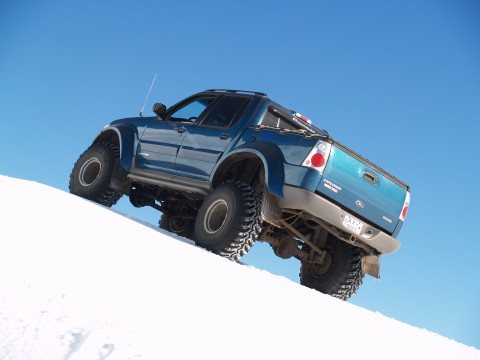
My first snow driving experience was in the 80's. I got a ride with my friend who had a Chevy C-10 on 38 inch Monster Mudder tires and another friend on a Blazer also on Mudders. I just had to get my own truck too!
Why Iceland builds them
Most of Iceland's interior is a highland desert of lava, gravel and glacier rivers, with roads that are open only a few months a year. In winter the whole highland is under snow, and the big ice caps (Vatnajökull, Langjökull, Hofsjökull, Mýrdalsjökull) are snow-covered all year.
A normal 4x4 on 31-inch tires breaks through soft snow and gets stuck. Icelanders found that a much bigger tire, run almost flat, stays on top. Over the decades that idea grew into a local building tradition, with clubs, specialist shops, tour companies and a rescue service that all run super jeeps. Most of them are still built in home garages.
It starts with the tires
Everything on a super jeep is built around the tire size. The usual steps:
| Tire size | Metric (approx.) | What it is used for |
|---|---|---|
| 33–35" | 84–89 cm | Light highland trips in summer. Not a super jeep in winter. |
| 38-41" | 97-105 cm | The classic starting point for snow and glacier driving. |
| 44-49" | 112-125 cm | Deep snow and long glacier trips. Very common on Hilux and Patrol builds. Tour trucks and heavier vans that need more flotation. |
| 54" and bigger | 140 cm + | Big trucks, a few private builds and expedition vehicles. |
Width matters as much as height. A 44 x 18.5 tire puts down a far wider footprint than a narrow 44, and in snow that is what keeps you on top.
Studs are common for ice. Many drivers also cut or sipe the tread for grip in wet snow. Chains are rare, for reasons explained in Why No Chains In Iceland?, and the old debate about tire construction is covered in Radial vs. Bias for deep snow.
Want to see what a tire size does to your own rig? The Big Tire Planner draws your truck on anything from stock size up to 54-inch tires and works out the gearing.
Lift, cut and flare
Icelandic builders lift only as much as the tire needs. A super jeep is often lower than a US rock crawler on the same tire size, because a low center of gravity matters more on side slopes and in wind than extra clearance under the axles.
A typical build combines:
- A modest suspension lift, often with longer links or a solid axle swap in front when the stock independent suspension cannot take the tire.
- A small body lift on body-on-frame trucks.
- Cut wheel arches, sometimes moving the firewall or inner fenders so the tire can turn and move up.
- Wide fender flares, required to cover the tire.
Gearing: getting the power back
A 44-inch tire is about 40% taller than a 31-inch one, so the truck feels like it is always in a gear too high. Super jeeps are almost always regeared, often to 4.88, 5.29 or 5.71, and many add a lower transfer case range for crawling in deep snow.
The rule of thumb is simple: new ratio equals old ratio times new tire size divided by old tire size. Our Gear Ratio Chart has the full table, and the Big Tire Planner does the sums for your own truck.
Front and rear lockers are standard. In soft snow you want all four tires pulling at the same speed.
Air down to float
The secret of a super jeep is tire pressure. On the road a 44-inch tire runs at about 20–25 psi. On a glacier drivers go down to 3–5 psi, and in very soft snow sometimes lower. At those pressures the footprint grows to more than twice its normal width and several times its length.
That takes some equipment:
- An onboard air compressor to pump back up when the snow firms up, or before driving on gravel again.
- Accurate low-pressure gauges accurate for the low psi.
- A second valve on each wheel, often without a core, for quick airing down and up.
- Beadlocks or a careful right foot, because at very low pressure a tire can come off the rim if you spin it hard with the wheels turned.
I typically will take the pressure all the way down to 1-2 psi on deep and soft snow.
Built in garages, checked by the state
Super jeeps are road-legal. In Iceland any modification that changes a vehicle's registration needs a modification inspection before the new registration is approved, and the truck then goes through normal inspections like any other car.
Any changes to tire size, lifting, suspension and changes to the steering mechanism as well as structural changes need approval. The cost can be from USD 300 and up!
The usual base trucks
- Toyota Hilux and Land Cruiser. The most common super jeeps, from home builds like this 1998 Hilux on 44s to Arctic Trucks conversions. More in 4x4 Toyota Iceland.
- Nissan Patrol. Solid axles front and rear, so it takes big tires well. See the 49-inch modified Patrol, Snow Bear and 4x4 Nissan Iceland.
- Ford. From Explorers and Sport Tracs on 38s, like this 2001 Sport Trac, to Super Duty trucks on 46s and bigger.
- Land Rover, Mitsubishi, Isuzu and Suzuki. Defenders, Pajeros and Troopers are classic snow trucks, and even Jimnys run on 33s.
Browse more on the make pages: Toyota, Nissan, Ford and Land Rover.
Where to see one
- Ride along. Several Reykjavík tour companies run super jeep day trips into the highlands and onto the glaciers, for example Superjeep.is and Mountaineers of Iceland.
- Build one. Workshops such as Arctic Trucks Iceland and Fjallasport do the conversions, the parts and the suspension work.
- Watch the madness. Super jeeps are the everyday cousins of the trucks in Icelandic Formula Offroad, where purpose-built buggies climb near-vertical walls.
- Glacier driving. See what it looks like in this Glacier Driving Video.
Driving on glaciers is only for well-equipped trucks in a group with people who know the ice. Crevasses and fast weather changes are real dangers. Check conditions on SafeTravel before any highland trip.
FAQ
What tire size makes a jeep a "super jeep"?
In Iceland 38 inches is the usual starting point. Below that it is a modified 4x4, from 38 inches and up it is a super jeep. Many run 44 or 46 inches.
How low do super jeeps run their tire pressure?
Around 20–25 psi on the road and 3–5 psi on snow and glaciers, sometimes lower in very soft snow. An onboard compressor pumps the tires back up.
Are super jeeps street legal in Iceland?
Yes. A modification that changes the registration needs a modification inspection, and after that the truck is registered and inspected like any other vehicle.
Why are Icelandic super jeeps not lifted very high?
Because the goal is flotation, not clearance. A big, soft tire carries the truck on top of the snow, and a low center of gravity keeps it stable on side slopes and in strong wind.
Can I ride in a super jeep as a tourist?
Yes. Many tour operators in Reykjavík run super jeep day tours into the highlands, onto glaciers and to the northern lights.